Private car QR code
The car QR code that lets people reach you without your phone number
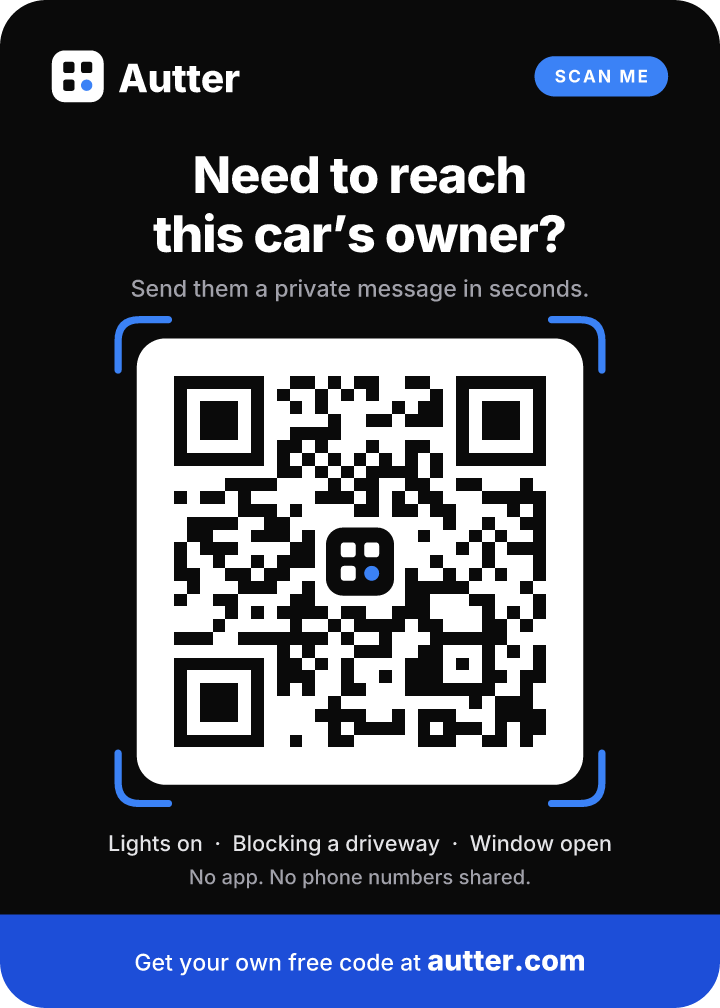
A privacy car QR code is a sticker in your windshield that lets anyone send you a message about your car without seeing your phone number. They scan it with their phone camera, pick a reason like "You're blocking my car", and you get a text alert. The messaging is one-way: they can't see who you are, and you only see their number if they choose to share it.
Updated October 2026
Autter in 30 seconds
- Cost: free for individual drivers.
- Setup: about 60 seconds with a mobile number (Canada and US) or an email address anywhere else. No car details or license plate needed.
- Sender needs: a phone camera. No app, no account. They stay anonymous unless they choose to share their number.
- What's in the QR code: a random code. Not your name, number, email or plate.
- Messaging: one-way. Strangers can't start a chat or see past messages.
- Alerts: text message in Canada and the US, email everywhere, plus optional browser notifications.
- Controls: pause, replace or block anytime. A replaced code stops working right away.
Why you shouldn't leave your phone number on your car
Putting your phone number on your dashboard, or a sticky note with your number in the window, does solve one problem: people can reach you when you're blocking them in. But it creates bigger ones.
- Anyone walking by can copy it. That includes people you'd never give your number to.
- Your number leads to you. A mobile number is often enough to find a name, and sometimes more, through people-search sites and data brokers.
- It's tied to where you park. A number on a car parked outside your home or office every day connects you to those places.
- It invites spam and scams. Once it's out, you can't take it back. Changing your number is the only real fix.
- It's two-way by default. Whoever has your number can call or text you anytime, about anything.
What you actually want is narrower: let people reach you about your car, when it matters, without giving them a way to reach you about anything else. That's the job of a privacy car QR code.
How a privacy car QR code works
Autter replaces the phone number in your window with a QR code for your car that points to a private message form. Here's the full flow:
- 1You sign up with your mobile number (or your email outside Canada and the US) and confirm it with a one-time code.
- 2Autter creates your QR code. It contains a random code that links to a message form, nothing else.
- 3You print it and place it inside your windshield. See how to print your car sticker.
- 4Someone scans it with their phone camera. A web page opens. No app, no sign-up.
- 5They pick a reason (blocking, lights on, window open, damage, tire, needs to move, security, or other) and edit the suggested message if they want.
- 6You get an alert by text or email and read the message in your private inbox.
The sender never learns your name or number. You never learn theirs unless they tick "share my number" so you can call them back. Read the full walkthrough on how Autter works.
One-way messaging: receive messages without revealing your phone number
Most "anonymous text" apps are built for two people to chat. A car QR code needs the opposite: a stranger should be able to send you one useful message, and that's it. Autter is one-way by design.
| The car owner (you) | The person who scans | |
|---|---|---|
| Phone number | Hidden from the sender | Hidden, unless they choose to share it |
| Name and profile | Never shown | Never collected |
| What they see | Reason, message, time, and the sender's number only if shared | A confirmation that the message was sent |
| Can they reply in the app? | No. Call or text back yourself only if they shared a number | No. They can't see your profile, past messages, or whether you read it |
| Can they start a conversation? | No | No |
Because nothing on the sticker identifies you, it's safe to leave in your car all day, every day. The QR code is the contact point, not your phone number.
Car QR code vs a note, a phone number, or a plate lookup
There are four common ways people try to reach a car owner. Here's how they compare when your goal is to be reachable without giving up your privacy.
| Method | Reaches you fast? | Hides your number? | Works when you're away? | Downside |
|---|---|---|---|---|
| Note on the windshield | No. You see it when you get back | Yes | No | Too late for blocking, lights, rain |
| Phone number on the dashboard | Yes | No | Yes | Public, permanent, invites spam |
| License plate lookup | No | Yes | No | Owner contact info is legally restricted |
| Calling 311 or parking enforcement | Slow | Yes | Yes | Often ends in a ticket or a tow |
| Autter car QR code | Yes. Text alert in seconds | Yes | Yes | Only works on cars that have one |
Notes still have a place. If you hit a parked car, most places require you to leave your name and contact details, and a QR message doesn't replace that legal duty. For everything else, a fast private alert beats a note found an hour too late.
Can you find a car owner by license plate?
Usually not, and that's on purpose. In the US, the federal Driver's Privacy Protection Act (18 U.S.C. § 2721) limits when state motor vehicle departments can release personal information from vehicle records. Being blocked in isn't one of the permitted reasons. Canadian provinces also restrict access to owner information in their registries.
"Free license plate lookup" sites can return vehicle details like make, model and recalls. They generally can't give you the owner's phone number.
That's exactly the gap a car QR code fills. The owner opts in to being reachable, on their terms, without anyone needing their plate or their identity.
When a car QR code helps
Someone is blocking your driveway, or you're blocked in
A car blocking your driveway is one of the most searched parking problems. The usual options are waiting, calling 311 or parking enforcement, or paying for a tow. If the car has an Autter code, you send "You're blocking my car" and the owner gets a text right away. And if it's your car doing the blocking, you get the chance to move it before a ticket.
Headlights left on
A battery doesn't wait for you to find a note. A quick "Your lights are on" alert can save a jump-start.
Window open, rain coming
Neighbours and passers-by notice these things. Now they have a way to tell you.
Damage, a flat tire, or something suspicious
Someone who saw a door ding or a flat can tell you right away, and can choose to share their number if they witnessed something.
EV charging spots, shared lots and building parking
Done charging and someone's waiting? Building manager needs the spot? Snow removal coming? These are everyday reasons to reach a driver you don't know.
A car alarm that won't stop
Whether it's your car or a neighbour's, the owner can only fix it if someone can reach them.
Is a car QR code safe?
It's a fair question. The FTC has warned that scammers hide harmful links in QR codes, including fake codes stuck on parking meters that ask for payment. Here's how Autter is built to stay on the right side of that:
- It never asks for money. Scanning an Autter code opens a message form on app.autter.com. No payment, no login, no download.
- Nothing personal is encoded. The QR code holds a random code, so scanning it reveals nothing about you.
- Abuse protection on every code. Rate limits, spam filtering and bot protection.
- You stay in control. Block a sender, report a message, pause your code, or replace it. The old code stops working immediately.
- No tracking. Autter doesn't collect your car's location or track people who scan your code.
Other ways to hide your phone number, and why they don't fit a car
There are good tools for keeping your phone number private: blocking caller ID on outgoing calls, second-number apps, and messaging usernames. They protect you when you contact someone. A car has the opposite problem: strangers need to contact you, and you don't know who they are in advance.
A second phone number on your dashboard is still a public number that anyone can call or text forever. A car QR code only lets people send a short message about your car, and you can switch it off whenever you want.
How to set up your car QR code in about a minute
- 1Sign up with your mobile number or email and enter the code we send you.
- 2Your QR code is ready right away. Download the sticker as a PDF.
- 3Print it at home or at a print shop. See printing tips and sizes.
- 4Place it inside your windshield, where it's easy to scan from outside.
- 5Choose how you want to be alerted: text, email, or browser notifications.
Autter is available in English, French, Spanish and Arabic, and was made in Montréal.
Car QR code questions
What is a car QR code?
A car QR code is a sticker for your windshield that people can scan with a phone camera to contact you about your car. Autter's version opens a private message form, so the person can tell you you're blocking them or your lights are on without ever seeing your phone number.
Can someone get my phone number from my car QR code?
No. Your Autter QR code contains a random code that links to a message form. It never contains or reveals your phone number, name, email, or license plate, and the person who scans it only sees a confirmation that their message was sent.
Is it safe to put my phone number on my car?
It's risky. A number in your window is visible to everyone, can be linked back to you, and can be used to call or text you about anything, forever. A privacy car QR code gives people a way to reach you about your car without exposing the number.
How can I contact a car owner without their phone number?
If the car has an Autter QR code, scan it with your phone camera, pick what's going on, and tap Notify owner. No app or account is needed. If there's no code, your options are a note on the windshield, local parking enforcement or 311, or 911 in an emergency.
Can I find a car owner by license plate?
Generally not. In the US, the Driver's Privacy Protection Act restricts when motor vehicle departments can release owner information, and Canadian provinces restrict access too. Lookup sites can show vehicle details but usually not the owner's contact information.
Can the car owner reply to me?
Not through Autter. Messages are one-way so strangers can't start a conversation. If you choose to share your phone number when you send the message, the owner will see it and can call or text you themselves. Sharing is off by default.
Does the person scanning need an app?
No. Any phone camera that reads QR codes opens a regular web page. There's no app to install and no account to create, for the sender or the owner.
What if someone sends me spam or abusive messages?
Block the sender and report the message from your inbox. You can also pause your QR code or replace it with a new one, and the old code stops working immediately. Every code is protected by rate limits and spam filtering.
How much does Autter cost?
Autter is free for individual drivers. You print the sticker yourself, at home or at any print shop.
Be reachable about your car. Stay private about everything else.
Get your free car QR code in about a minute. No app, no plate, no phone number on display.
Get my free QR code